
Chapter 14: Biohazardous Spill Response
Preparing for Biohazardous Spill Cleanup
Spill Cleanup Materials
Each laboratory must have a spill kit available to respond to the largest spill anticipated for that area. At a minimum, the following spill cleanup materials should be available in the laboratory:
- Disposable gloves (e.g., nitrile)
- Safety glasses or safety goggles
- Lab coat, apron or smock to protect clothing and body
- Absorbent materials (e.g., Pig Pad, paper towels)
- Disinfectant appropriate for the agents used in the laboratory
- Forceps or other devices to pick up contaminated material (especially sharps)
- Autoclavable biohazard bags
Biohazardous Spill Cleanup Risk Assessment
Several factors must be considered when assessing the risk that a spill presents:
- Volume and concentration of the spilled material
- The infectious dose of the spilled material and routes of exposure
- Location of the spill
- Degree of aerosolization of the agent resulting from the spill
- Susceptibility of the spilled material to disinfection
- Nature of the affected surface(s)
As with any spill scenario (biological, chemical, or radiological), the safety of personnel is the most important consideration. Cleanup is to begin only after it is determined that the personnel who will clean up the spill have appropriate knowledge, training, and equipment.
Spills Involving Recombinant and/or Synthetic Nucleic Acid Molecules
All spills involving recombinant and/or synthetic nucleic acid molecules (including biological agents that have been genetically altered) must be reported to the Biosafety Officer.
General Decontamination/Spill Cleanup Procedure
The following are general biohazardous spill cleanup procedures that are appropriate for most spill scenarios; however, the appropriate response to any spill is based on an assessment of the risk associated with that particular situation.
- Put on proper PPE
- Place an absorbent material (paper towel, bench diaper) over the contaminated surface, then add liquid disinfectant; this will prevent spread of contamination.
- Allow sufficient contact time after applying the disinfectant. If the contact time is too brief, the surface will not be thoroughly disinfected.
- When cleaning a spill of concentrated material or if the disinfectant must act on an uneven surface, allow extra time for the disinfectant to act.
- Avoid using concentrated or undiluted solutions of your disinfectant to “speed up” the inactivation process. The surface that is being disinfected may be adversely affected by strong chemicals. This is especially significant when working with bleach, which is a very strong corrosive. Some disinfectants will leave a residue of chemicals behind.
- Rinse the cleaned area with distilled water to avoid adverse effects on your experiment. This is especially important in tissue culture rooms where a cell line can be wiped out by disinfectant residue left on equipment.
How to Clean a Contaminated Surface
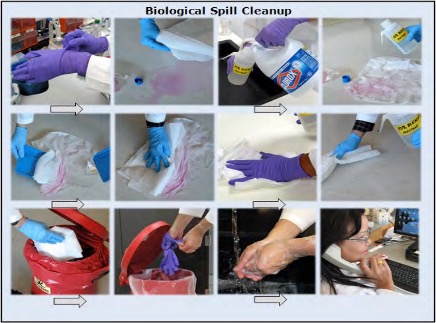
- Choose disinfectant based on biological present in spill.
- Length of time required for contact depends upon biological and disinfectant.
- Dispose of materials as medical waste.
- Report incident as required.
Courtesy of https://ehs.stanford.edu/manual/biosafety-manual/decontamination
Call the BSO or EHS with any questions or concerning spills.
Biohazardous Spills Inside Biosafety Cabinets (BSCs)
- Wear a lab coat, safety glasses, and gloves during cleanup.
- Allow the BSC to run continually during cleanup.
- Surround the affected spill area with absorbent material to prevent spread of the spill.
- Apply disinfectant appropriate for the biological agent and allow a minimum of 20 minutes contact time (or as directed by manufacturer’s instructions). Alcohol or other flammable liquids are not recommended.
- Wipe up the spill with a disposable cloth or a towel soaked with disinfectant.
- Wipe the BSC’s walls and work surface, as well as any equipment in the cabinet, with a disinfectant- soaked cloth.
- Place contaminated items in an appropriate container (biohazard waste bag, sharps container, or autoclavable pan with lid for reusable items) for autoclaving.
- Remove protective clothing and place in a biohazard waste bag for autoclaving.
- Thoroughly wash hands and forearms with soap and water.
- Allow BSC to run for a minimum of 10 minutes before resuming work in the cabinet or shutting off the cabinet.
Biohazardous Spills in the Laboratory, Outside the BSC
- Alert others in the area.
- Remove any contaminated clothing and place in a biohazard waste bag for autoclaving.
- Wash all areas affected by skin contact with soap and water.
- Wear a long-sleeved gown or lab coat, shoe covers, safety glasses, and gloves.
- Place absorbent material over the spill.
- Pour disinfectant around the spill, working from the outside of the spill to the center.
- Disinfect all items in the spill area (e.g., counter, cabinet, equipment).
- Allow a minimum of 20 minutes of contact time (or as directed by manufacturer’s directions) with the disinfectant.
- Place contaminated items in an appropriate container for autoclaving (biohazard waste bag, sharps container, or autoclavable pan with lid for reusable items).
- Use tongs/forceps or plastic scoops to pick up sharps.
- Remove protective clothing and place in a biohazard waste bag for autoclaving.
- Thoroughly wash hands, forearms, first and then other potentially contaminated body parts with soap and water. It is recommended that cleanup personnel shower as soon as possible.
Biohazardous Spills Inside a Centrifuge
- Clear the area of all personnel and allow aerosols to settle (usually a minimum of 30 minutes) before re- entering the area.
- Wear a lab coat, safety glasses, and gloves during cleanup.
- Transfer the rotor and buckets to a BSC for cleanup. Do not open rotor or buckets outside of the BSC.
- Using an appropriate disinfectant, thoroughly disinfect the inside of the centrifuge, the rotor, and buckets.
- Discard cleanup materials and PPE as biohazardous waste.
- Thoroughly wash hands, forearms, and other parts of the body with soap and water.
Biohazardous Spills Outside the Laboratory During Transport
All biological agents are to be transported from the laboratory must follow UM’s Transporting Biological Agents policy. In the event a transport container drops, and its contents are spilled, the following procedures should be followed:
- Immediately clear the area of all personnel and secure the area.
- Attempt cleanup only if appropriate cleanup materials and protective clothing are available.
- Notify the BSO.
When responding to a spill, the following rules should be followed:
Tend the injured: Ensure receipt of immediate medical care and do not attempt to move the injured individual(s) unless ambient conditions become life-threatening. Individuals splashed, sprayed with, or otherwise exposed to human blood or other body fluids or tissues during a spill will need to remove contaminated clothing and utilize basic first aid.
- Wash any wounds immediately with soap and
- Await assistance: Unless laboratory personnel are trained and properly supplied with PPE, do not attempt to clean up the spill. Personnel should immediately call the Biosafety
- Isolate the spill: Evacuate the immediate spill area or the entire room in the case of an aerosolizing (splashing or spraying) spill or a spill of volatile material. Prevent others from entering the spill area with barricades or, if necessary, a
- Remove contaminated PPE and don new PPE prior to cleaning
- Contain the spill: Place absorbent material around, on, or in the flow path of the spilled material only if it can be done safely.
- Provide information: Provide the information requested by the Biosafety Officer or EHS personnel and await arrival of the emergency provider.
- Clean up: Clean up should take place only if laboratory personnel are trained, properly supplied with PPE, and otherwise able to clean up and disinfect the spill safely