
Chapter 8: Laboratory Biosafety Practices
Individuals working with infectious organisms or biohazardous materials must be aware of potential hazards and be trained and proficient in the practices and techniques required for handling such material safely. The PI is responsible for ensuring that laboratory personnel are properly trained; the PI may delegate the provision of training to the laboratory supervisor, but the responsibility remains with the PI.
Each laboratory must develop a lab-specific biosafety manual identifying specific hazards that may be encountered, along with specific practices and procedures that will minimize risk(s) to lab personnel. All lab members are required to read and follow the required practices, procedures, and be apprised of any special hazards. The PI or supervisor who is directing laboratory activities should be well-trained, experienced, and knowledgeable in the appropriate laboratory techniques, safety procedures, and hazards associated with the handling of infectious organisms and/or biohazardous material.
When standard laboratory practices are insufficient for the control of specific hazard(s) from an infectious organism, biohazardous material, or procedure, the PI will select additional safety measures to prevent exposure, and thereby ensure the safety of his/her lab personnel. These practices must also be supplemented by appropriate engineering controls, administrative controls, PPE, and SOPs.
The PI has ultimate responsibility for ensuring that persons working in the laboratory are adequately trained and that they follow the appropriate safety measures.
Basic Laboratory Practices
Prudent practices and good techniques are of primary importance in laboratory safety. Both are based on sound technical knowledge, experience, and an attitude of courtesy and consideration for others.
Techniques and practices are described in detail as “Standard Microbiological Practices” in the CDC/NIH’s Biosafety in Microbiological and Biomedical Laboratories and the NIH Guidelines, see appendix C.
Standard microbial practices include the following:
- Do not eat, drink, smoke, or apply cosmetics in the laboratory.
- Wash hands after work is complete, after gloves are removed, or if there is a glove compromise (i.e., glove tear).
- Wear PPE at all times when working: lab coat, disposable gloves (e.g., nitrile or latex), and safety glasses.
- Remove personal protective equipment (PPE) and wash hands before exiting the laboratory to prevent cross-contamination between individuals and research areas.
- Do not mouth pipette.
- Decontaminate work surfaces before and after work, and immediately after spills.
- Perform all manipulations that have the ability to create aerosols in a biological safety cabinet (BSC), or other containment device.
- Reduce the use of needles and other sharps when possible.
Laboratory Housekeeping and Personal Hygiene
Personal safety is greatly enhanced by keeping the workspace neat, clean, and orderly. Injuries and exposures are more likely to occur in poorly maintained, disorderly areas. All materials must be properly labeled, and waste discarded. Contact EHS for disposal of hazardous materials. Do NOT pour chemicals down the drain unless approved by EHS.
The following guidelines will be observed in the laboratory:
- Routine housekeeping and regular disinfection of lab equipment are necessary to ensure work areas are free of sources of contamination and hazards.
- Laboratory personnel are responsible for cleaning laboratory benches and equipment.
- Access to exits, sinks, eyewashes, emergency showers, and fire extinguishers must not be blocked.
- The workplace should be free of physical hazards.
- Equipment should be properly grounded. Use only properly approved extension cords or surge protectors. Overloaded electrical circuits and the creation of electrical hazards in wet areas must be avoided.
- Surfaces must be clean and free of infrequently used reagents, glassware, and equipment.
- Eliminate trip hazards (e.g., items on floors, under benches, or in corners).
- All compressed gas cylinders must be properly secured.
- Proper hand washing immediately after de-gloving ensures that potential contamination of the hand is removed before being spread.
The laboratory is an inappropriate place to perform personal cosmetic tasks, such as applying makeup, cleaning or trimming fingernails, or brushing hair. These activities provide potential for exposure and may contribute to contamination of the laboratory environment.
Laboratory Furniture
Laboratory furniture should be capable of withstanding anticipated loading and uses. Spaces between benches, cabinets, and equipment should be accessible for cleaning. Chairs and other furniture used in laboratory work must be covered with a non-fabric material that can be easily decontaminated. Carpets and rugs in laboratories are not appropriate.
Universal Precautions
The principal of universal precaution is defined by the Bloodborne Pathogens (BBP) Standard. This practice should be adopted by all laboratory personnel. Universal precautions require that all human blood, tissues, and other bodily fluids be handled as though they are infectious. Adopting and applying universal precautions to all laboratory activities creates an awareness of potential risks and adds another level of vigilance.
Biological Hazard Information
Laboratory workers must be knowledgeable about the hazards associated with the infectious organisms or biohazardous materials in their labs. Detailed hazard information, including Pathogen Safety Data Sheets, is available to all laboratory workers.
Posting-Labeling and Storage
The necessity for establishing policies and procedures for proper identification of hazardous biological agents within UM laboratories is to alert support and emergency personnel who may enter the area to take precautionary measures and to restrict traffic to potentially hazardous areas.
Biohazard Signs and Labels
Proper posting, labeling, and storage of biohazardous materials are essential for maintaining a safe laboratory environment, ensuring regulatory compliance, and protecting personnel, support staff, and emergency responders. These practices help to identify potential hazards, control access to restricted areas, and enable effective emergency response.
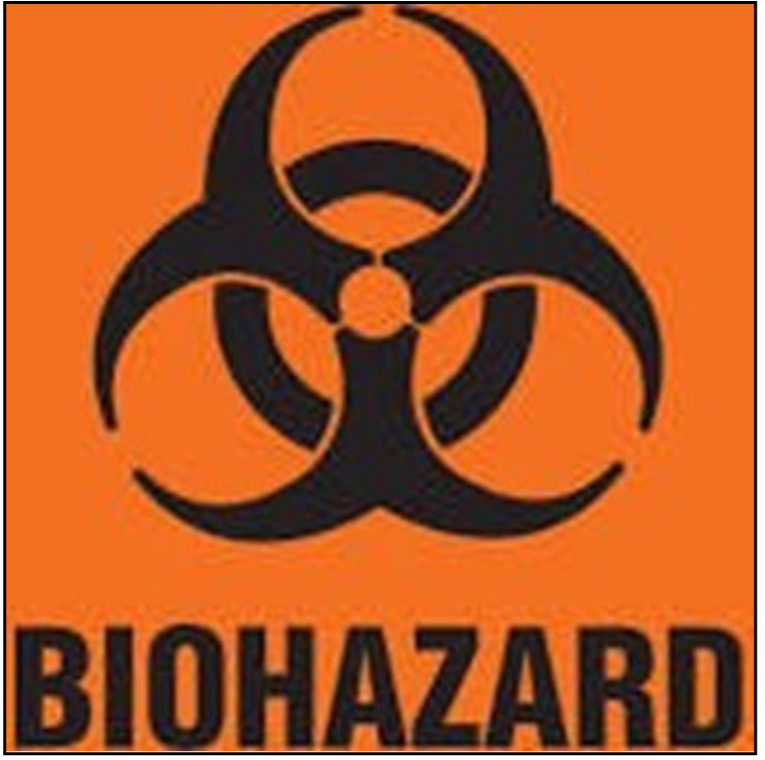
All laboratory doors to areas where biohazardous agents are used or stored must be posted with a laboratory-specific door sign. This sign must clearly indicate the laboratory’s biosafety level—typically Biosafety Level 2 (BSL-2)—and state that entry is restricted to “Authorized Personnel Only.” Specific agent names are not posted on the sign for security and confidentiality reasons. Door signs must display the universal biohazard symbol and include the name and telephone number of the Principal Investigator (PI), as well as any special procedures for entering or exiting the space.
In accordance with the Occupational Safety and Health Administration (OSHA) Bloodborne Pathogen Standard, all containers of human blood and other potentially infectious materials (OPIM)—including contaminated waste, refrigerators, freezers, and transport containers—must be clearly labeled with the universal biohazard symbol. This regulation is mandatory and applies to all laboratories working with human materials.
The universal "Biohazard" warning labels must be used to identify the following items:
- Containers of infectious materials; including waste and storage
- Refrigerators
- Incubators and/or freezers where biohazards are stored
- Equipment which may be contaminated through normal use of biohazards
- Laboratory animals (cages) which are potentially infectious. In addition, the cage will also be labeled with the specific agent administered to the animals
Storage of Biohazard Materials
Biohazard labeling requirements apply not only to signage, but to all containers and equipment used for storage, transport, or disposal of biohazardous materials. All biological agents must be stored in leak-proof, sealed primary containers that are clearly labeled with the identity of the contents. These primary containers must be placed within secondary containers that also display the universal biohazard symbol. Including the identity of the materials on the secondary container is strongly encouraged. Refrigerators, freezers, incubators, and other storage units used to store biohazardous materials must be labeled with the biohazard symbol. Similarly, equipment that may be contaminated during use—such as centrifuges, biosafety cabinets, and transport bins—must be clearly labeled. Waste containers and equipment awaiting decontamination must also bear the biohazard symbol to ensure proper handling.
To ensure long-term integrity and safety, materials stored for extended periods must be inspected at least annually. During these inspections, each container must be checked for leaks, cracks, or signs of degradation. Damaged containers must be replaced or properly discarded. Expired or unneeded materials must be decontaminated using an appropriate method (e.g., autoclaving or chemical disinfection) before final disposal, following the institution’s biohazard waste protocols.
In the event of equipment failure, such as a freezer melt-down, materials that cannot be salvaged must be decontaminated and disposed of promptly. Approved methods of decontamination include autoclaving and the use of EPA-registered disinfectants effective against the relevant biological agents. Following decontamination, materials must be disposed of as biohazardous waste in compliance with institutional and federal guidelines. Contact the Biosafety Officer or EHS general notification and guidance.
Microbial Agents
The CDC/NIH’s Biosafety in Microbiological and Biomedical Laboratories (BMBL) has descriptions of biosafety levels and recommended biosafety practices for specific biological agents.
The Public Health Agency of Canada maintains Pathogen Safety Data Sheets for biological agents. The American Biological Safety Association (ABSA) maintains a database for biological agent risk groups.
Security and Inventory of Biological Agents
Each PI must develop site-specific criteria that safeguard all biological materials, regardless of their risk group, from unauthorized removal. It is the PI’s responsibility to ensure that his/her laboratory implements sufficient security measures and procedures to prevent unauthorized access to biological agents.
Each PI shall have an inventory of the biological materials stored in the laboratory. This inventory may be digital or hard copy.
Annual Laboratory Inspections
Annual Biosafety and general health & safety compliance inspections are conducted for work performed at BSL-1 and BSL-2 containment. The inspections ensure the lab's facilities, training, and work practices are appropriate for the approved biosafety level.
The biosafety inspection will cover the biological aspects of the research and the lab’s IBC registration. A person (PI, Lab manager or designee) who can discuss details of the biological work must be present on the inspection.
Inspection Management
Accurate records and documentation are a critical part of any Biosafety Program. In order to prove that specific requirements of the Biosafety Program have been accomplished, appropriate documentation must be maintained.
Documentation is required for the following items:
|
Category |
Required Documentation |
Notes/Examples |
|---|---|---|
|
Training Records |
|
Ensure training is current for all lab personnel; retain documentation for 3+ years |
|
Standard Operating Procedures (SOPs) |
|
SOPs should be accessible, dated, and reviewed/updated at least annually |
|
Chemical Inventory (EHS) |
|
Should be accurate and match labeled containers in the lab |
|
Biological Materials Inventory |
|
Include source, risk group, storage location |
|
Hazardous Waste Records (EHS) |
|
Follow EPA, OSHA, state, local and institutional guidelines |
|
Equipment Maintenance |
|
Must be within certification period (e.g., annual for BCSs) |
|
Safety Signage |
|
Signage must be visible, up to date, and reflect current hazards |
|
Incident Reports |
|
Ensure reports are documented and reviewed and reviewable for corrective actions |
|
Emergency Plans |
|
Personnel should be trained on these procedures |
|
Personal Protective Equipment (PPE) and Respiratory Protection |
|
Documentation should include PPE and Respiratory Protection selection and use guidance |
|
IACUC or IBC Protocols |
|
Must be current and matched with actual lab practices |
|
Controlled Substances (if applicable) |
|
Stringent documentation and security measures required |
Prevention of Aerosols and Droplets
Handling of liquids or dry powders often generates aerosolized powders, liquids or droplets. High-energy procedures such as centrifuging, vortexing, and mixing, tend to produce aerosols that stay airborne for extended periods and are small enough to be inhaled; low-energy procedures, including opening containers and streaking plates, produce droplets that settle quickly on surfaces, skin, and mucous membranes.
Biological Safety Cabinets
The following guidelines are recommended when using biological safety cabinets (BSCs). Refer to Appendix B for differences between laboratory hoods.
- The BSC must be certified when it is installed or after it is moved, and annually thereafter (for information on cabinet certification contact the BSO). The Magnehelic gauge should be checked regularly. This gauge will normally run at a relatively fixed value. The value is written on the certification sticker at the time of certification. When it deviates significantly, the cabinet must not be used until the cause of the deviation has been identified and fixed.
- Personnel must understand and acknowledge how the BSC works.
- If the BSC contains a UV light, personnel must be familiar with the safe and effective use of any UV lamps inside the BSC and use appropriate precautions to avoid UV-related injuries. The UV light is not considered a method of decontamination.
- The BSC’s protective airflow pattern should not be disrupted. Rapid arm movement, nearby workers, and open laboratory doors may disrupt the airflow pattern and reduce the cabinet’s effectiveness.
- The BSC must run for at least 5 minutes to allow for stabilization of airflow before any procedures are begun.
- The BSC must be left running whenever the cabinet is in use.
- Work and the necessary materials should be planned to minimize the need to exit and reenter the BSC.
- Accumulation of materials in the BSC should be minimized to reduce turbulence and ensure proper laminar airflow.
- Work surface must be disinfected after each use.
- Any piece of equipment (e.g., centrifuge, blender) capable of creating air turbulence should be placed in the back one-third of the BSC. All other work should be stopped while this equipment is operating.
- Open flames are not allowed inside the BSC because they create airflow turbulence which compromises sterility. Electric devices, such as loop sterilizers, are satisfactory alternatives to open flames.
- Flammables and other volatile chemicals are not permitted to be used in a BSC.
- A pan with disinfectant and/or a sharps container is placed inside the BSC for pipette/sharps disposal. Vertical pipette discard canisters on the floor outside the cabinet should be avoided.
- Contaminated and clean items should be segregated, and personnel should work from “clean to dirty.”
- A biohazardous waste collection bag is placed in the BSC to collect waste.
- Do not block air flow into the front and rear grilles.
- All spills in the cabinet must be cleaned immediately. Work must cease until the spill is appropriately cleaned according to UM spill procedures, see chapter 14.
- When work is complete, all materials must be disinfected before being removed from the BSC, and all interior surfaces must be wiped with appropriate disinfectant.
- Gloves must be removed after touching or handling contaminated materials or if compromised (torn or hole).
- Laboratory coats must be removed, and hands thoroughly washed before leaving laboratory.
Utilization of Pipettes
Pipettes are used for volumetric measurements and the transfer of fluids that may contain infectious, toxic, corrosive, or radioactive agents. Laboratory-associated infections have occurred from oral aspiration of infectious materials, mouth transfer via a contaminated finger, touching face (eyes, nose, etc.) and inhalation of aerosols.
Exposure to aerosols may occur when liquid from a pipette is dropped onto the work surface; when liquids are mixed by pipetting (creation of bubbles); or when the last drop of liquid is blown out.
The following safe pipetting techniques will minimize the potential for exposure to hazardous materials:
- NEVER mouth pipette. Always use a pipetting aid.
- Do not prepare infectious organisms or biohazardous materials by bubbling expiratory air through a liquid with a pipette.
- Do not forcibly expel infectious organisms or biohazardous material out of a pipette.
- When pipetting, avoid accidental release of infectious droplets.
- Do not discharge material from a pipette at a height above the receptacle. Whenever possible, allow the discharge to run down the container wall instead.
- Place contaminated, reusable pipettes horizontally in a pan containing enough liquid disinfectant to completely cover them.
- Discard contaminated, broken, or intact Pasteur pipettes and broken glass in a sharps container.
- Dispose of the sharps container properly when it has reached the full line marked on the container.
- Pans or sharps containers for contaminated pipettes should be placed inside the BSC.
- Proper procedures for disposal of plastic pipettes are presented in Chapter 14.
Utilization of Centrifugation
Hazards associated with centrifuging include mechanical failure and the creation of aerosols. To minimize the risk of mechanical failure, centrifuges must be cleaned regularly, maintained, and used according to the manufacturer’s instructions. Users must be trained on proper operating instructions that include safety precautions of the centrifuge unit.
Aerosols are created by activities such as filling centrifuge tubes, removing plugs or caps from tubes after centrifugation, removing supernatant, and re-suspending pellets. A significant aerosol hazard can also be created if a tube breaks during centrifugation.
To minimize the generation of aerosols when centrifuging biohazardous material, the following procedures are recommended:
- Use sealed tubes and safety buckets that seal with O-rings. Before use, inspect tubes, O-rings, and buckets for cracks, chips, erosions, bits of broken glass, etc.
- Fill and open centrifuge tubes, rotors, and accessories in a BSC, if appropriate.
- Ensure tubes being used are rated for the centrifugation speeds required.
- Avoid overfilling centrifuge tubes to prevent closures from becoming wet. After tubes are filled and sealed, wipe them down with disinfectant.
- In the event of breakage during centrifugation, rotors/buckets should be opened inside of a BSC, and the centrifuge should be immediately decontaminated.
- Always balance buckets, tubes, and rotors properly before centrifugation.
- Avoid decanting or pouring off supernatant; use a pipette to remove the supernatant.
- Work in a BSC when re-suspending material. Use a swirling rotary motion rather than shaking. If shaking is necessary, wait a few minutes to permit the aerosol to settle before opening the tube.
- Small, low-speed centrifuges may be placed in a BSC during use.
Utilization of Cryostats
Use of cryostats is very common in many research laboratories. These devices pose potential hazards associated with sharp cutting edges and cold environments and must be handled with extra care.
The following guidelines should be followed when using cryostats:
- Frozen sections of unfixed human tissue or animal tissue infected with an etiologic agent pose a risk because freezing tissue does not necessarily inactivate infectious agents. Use of freezing propellants under pressure is not recommended with frozen sections because they may cause spattering of droplets of potentially infectious material.
- Appropriate gloves should be worn during preparation of frozen sections.
- When working with human or infected animal tissue, consider the contents of the cryostat to be contaminated and decontaminate it frequently with 70% alcohol.
- Consider all tissue remnants potentially infectious; carefully remove such accumulations from the cryostat during decontamination.
- Handle microtome knives with extreme Stainless steel mesh gloves should be worn when changing knife blades.
- Staining solutions used on potentially infected frozen sections are treated as if they are contaminated and must be disposed of properly.
Utilization of Inoculating Loops
Flaming inoculating loops can result in spatter and the release of aerosols and droplets. Use of an electric micro incinerator is the preferred, safer alternative.
- Alternatively, disposable plastic loops and needles may be used for culture work where electric incinerators or gas flames are unavailable.
- Gas burners may not be used in a BSC. These burners can produce turbulence that disturbs the cabinet’s protective airflow patterns. Gas leaks can concentrate flammable gas and cause explosions.
- Electric sterilizers and micro incinerators must be used when working in a BSC.
Utilization of Miscellaneous Aerosol-Producing Devices and Activities
Use of any of the devices listed below results in considerable aerosol production. Blending, cell-disrupting, and grinding equipment should be used in a BSC when working with biohazardous materials.
Blenders
Safety blenders are designed to prevent leakage from the bottom of the blender jar. They provide a cooling jacket to avoid biological inactivation and can withstand sterilization by autoclaving.
- Blenders must be tested to ensure they are leak proof prior to use with any biohazardous material. Blenders can be tested with sterile saline or dye solution.
- The use of glass blender jars is not allowed because of the potential for breakage.
- When opening blenders, be cognizant of potential contamination hazards in the form of droplets that might become airborne or fall on the surfaces; liquid residue on the cap; and possible expansion of the volume due to aeration.
- Before opening the blender jar, allow the unit to rest for a minimum of five minutes to allow the aerosol to settle.
- Effective control of contamination can be achieved by placing the blender in a tray lined with absorbent pads, and inside a BSC.
- The device must be decontaminated after use.
Sonicators
Sonication is the use of sound-wave energy for dispersion, disruption, or inactivation of biological materials. Sonicators generate sound waves at very high frequencies (~20,000 + Hz range), which is outside normal hearing range. Be aware of these hazards:
- Noise: Although the 20,000-Hz frequency is outside normal hearing range, there are other sources of noise, such as vibration from any loose equipment or other items on the bench or the liquid itself. Contact Environmental Health and Safety for a noise evaluation.
- Tubes must have lids closed when utilizing sonicating water bath.
- Sonicators that utilize a vibrating probe should be used inside of a BSC when using infectious agents.
- Aerosols: Aerosols present a more serious potential hazard and must be taken into consideration.
- Observe all precautions listed above for blenders and lyophilizers.
Lyophilizers
Depending on lyophilizer design, aerosol production may occur when material is loaded into or removed from the lyophilizer unit.
- The vacuum pump exhaust must be filtered to remove any hazardous agents.
- After lyophilization is complete, all potentially exposed surfaces of the unit must be disinfected with the appropriate disinfectant.
- If the lyophilizer is equipped with a removable chamber, it should be closed off and moved to a BSC for unloading and decontamination.
- Vapor traps must be used whenever possible.
- Use filter topped tubes when possible.
Handling Lyophilized or Powdered Biological Agents
Biological agents are commonly stored and shipped as powders. Powdered biological agents pose a high risk of aerosolization with minimal disturbance. All Risk Group 2 (RG2)/Biosafety Level 2 powdered biological agents must be handled inside of a BSC. Powdered biological toxins must be handled inside of a BSC or chemical fume hood.
Rubber Stoppered Vials
Powdered biological agents may be stored in vials with crimped rubbed stoppers. When solubilizing a powder in a rubber stopper topped vial:
- Add diluent through rubber stopper via syringe and needle (Luer Lock or one-piece needle and syringe).
- Allow pressure differential within the vial to dissipate by withdrawing the needle above the meniscus and allowing the syringe plunger to be displaced.
- After adding diluent to vial, dispose of syringe and needle in sharps container.
Non-Sealed Vials
Some powdered biological agents are stored in vials that do not have a sealed top (e.g., glass ampule, snap cap tube). When solubilizing a powder in one of these containers:
- Do not use a needle to penetrate the lid of these containers.
- Wear gloves appropriate for the diluent being used.
- Open container slowly. It is best to not fully open the container. Slowly add diluent through the opened lid and then close the container.
Once dissolved, manipulation of the biological agent must follow the UM requirements based on risk group/biosafety level.
Ampoules
Opening ampoules containing liquid or lyophilized culture material should be performed in a BSC to contain aerosols. Sealed-glass ampoules used to store biohazardous material in liquid nitrogen have exploded, causing eye injuries. The use of polypropylene tubes (cryovials) eliminates this hazard.
Polypropylene cryovials are available in dust-free or pre-sterilized forms; each tube is fitted with a polyethylene cap and a silicone washer. Heat-sealable polypropylene tubes are also available.
- To open a sealed-glass ampoule, nick the neck of the ampoule with a file, wrap it in disinfectant- soaked disposable towel, hold the ampoule upright, and snap it open at the nick.
- Reconstitute the contents of the ampoule by adding liquid slowly to avoid aerosolizing the dried material.
- Mix the contents without bubbling and withdraw it into a fresh container. Discard the disposable towel and the ampoule’s top and bottom as biohazardous waste.