
Chapter 16: Transportation and Shipment of Biological Materials
The packaging and transportation/shipment of biological materials are subject to strict local, state, federal, and international regulations, which govern materials that are transported through the “public domain,” (i.e., roadways, airways, and sea lanes accessible to the public).
The intent of the packaging and transportation regulations is to prevent accidental exposure of personnel who may handle the material during its shipment. Therefore, certain general criteria apply to all possible transportation scenarios.
Transportation on Campus
Staff transporting biological agents on campus must follow the Transporting Biological Agents Policy.
Packaging and Shipping Infectious Agents
Please refer to UMs Shipping Manual for more detailed information on shipping infectious agents.
The International Air Transport Association (IATA) and US Department of Transportation (DOT) regulate shipment of hazardous substances. The IATA regulations apply to all air transport, both domestic and international flights. Following IATA’s Dangerous Good Regulations (DGR), latest edition, ensures that a package will also meet US Department of Transportation requirements for ground transport.
All responsibilities for packaging and shipment of these agents have been assigned to the shipper. Only properly trained personnel may prepare infectious materials for transport. The following is only a summary of the requirements for packaging and shipping of infectious agents and does not constitute proper training.
Definitions and Applicability
- Dangerous goods: any substance or material that is capable of posing an unreasonable risk to health, safety, and property when transported. Most infectious or biological materials are considered dangerous goods and therefore subject to shipping
- Infectious substances: substances which are known or reasonably expected to contain pathogens. Pathogens are defined as micro-organisms (including bacteria, viruses, rickettsia, parasites, fungi) and other agents, such as prions, which can cause disease in humans or
Infectious and Hazardous Material Classifications
|
Infectious Substance or Hazardous Material |
Definition |
|---|---|
|
Category B |
Infectious substances that do not meet Category A criteria; includes human or animal material for research, diagnosis, or treatment. |
|
Patient/Animal Specimens |
Materials with minimal likelihood of pathogens being present. |
|
Chemical Preservatives (Dangerous Goods in Excepted Quantities) |
Specimens preserved with chemicals such as ethanol, formaldehyde, or formalin. |
|
Dry Ice |
Solid carbon dioxide used for specimen preservation; sublimates to gas and must be handled with caution. |
Exempt Substances: the following substances are not required to follow the IATA or DOT regulations, but are still subject to UM transport policies on campus:
- Materials that do not contain pathogens
- Materials that contain fully inactivated or neutralized pathogens
- Environmental samples that do not pose significant threat of infection (e.g., food, water, soil, or dust samples)
- Substances containing micro-organisms that are non-pathogenic to humans or animals
- Human or animal specimens in which there is minimal likelihood that pathogens are present
- Dried blood spots, fecal occult blood screening tests, blood or blood products intended for transfusion, and tissues or organs intended for transplantation
The substance to be shipped must be classified as exempt from regulation, an exempt patient specimen, Category A, or Category B infectious substance. Once classified, proper shipping names and identification numbers can then be assigned to the material. Exempt patient specimens do not require shipping names and identification numbers.
Category A and B materials are assigned the following names and numbers:
Category A: assign one of two identifiers:
- Infectious substance affecting humans: UN 2814
- Infectious substance affecting animals: UN 2900
Note: If a material infects both humans and animals, use the Infectious substance affecting human code, UN 2814.
Category B: Biological Substance, category B: UN 3373
All regulated infectious substances, including Category A, Category B, and exempt patient specimens, must be triple packaged:
- The innermost primary receptacle(s) is leak-proof.
- A leak-proof secondary receptacle with absorbent material placed between the primary and secondary receptacles to prevent the release of liquid during transport and to shield multiple primary receptacles from making contact.
- Rigid outer packaging.
Shipments of Category A and Category B materials must be packaged according to IATA Packing Instructions 602 and 650 respectively.
Shipments containing dry ice must follow IATA Packing Instruction 904.
Staff must refer to the current packing instructions to ensure the materials are packaged correctly. Those guidelines require the following:
- Shipments must be prepared in such a way that they arrive at their destination in good condition and present no hazard to persons or animals during shipment.
- Outer packaging must meet structural strength requirements and carry defined specification markings.
- Packages must have at least one surface with minimum dimensions of 100 mm x 100 mm.
- An itemized list of contents must be enclosed between the secondary container(s) and the outer packaging.
- All packages containing infectious substances must be marked durably and legibly on the outside of the package with the name and telephone number of a person responsible for the shipment.
- The shipper must make advance arrangements with the recipient and the operator to ensure the shipment can be transported and delivered without unnecessary delay.
- Substances shipped refrigerated or frozen must carry the refrigerant outside the secondary container or in the outer packaging or an overpack. If wet ice is used, the outside packaging or overpack must be leakproof. If dry ice is used, the packaging must permit the release of CO2 gas.
- Primary and secondary containers must retain their integrity across the full range of pressures and temperatures experienced under normal and loss-of-refrigerant conditions.
Labeling
Package labeling is in the form of standardized pictures that must be affixed to the outside. The color and design of each label is prescribed in the IATA regulations. All labels must be at least 50 mm on the smallest side. Refer to IATA Packing Instructions for specific requirements.
For the purposes of infectious substances, five different labels must be considered:
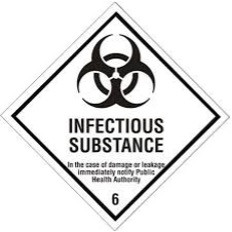
Category A
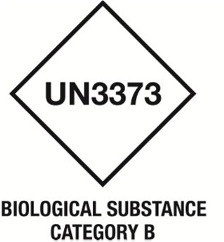
Category B
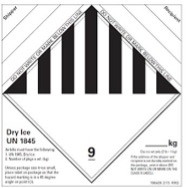
Dry Ice
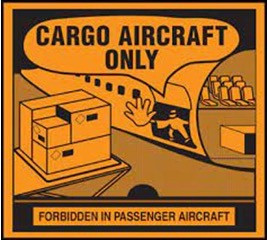
Cargo Aircraft Only
Must be affixed if shipping volumes greater than 50 ml of Category A substances.

Orientation Arrows
If shipping liquids, two such labels must be affixed to the package, on opposing sides.
Marking
Markings are the words and numbers required to be on the outside of a package.
The following markings must be present on any package containing a Category A or Category B material:
UN Number and Proper Shipping Name:
- UN 2814 Infectious substance affecting humans
- UN 2900 Infectious substance affecting animals
- Biological substance Category B
Contact Information requires the following:
- Name and telephone number of the responsible person
- 24-hour emergency telephone number in case of transportation emergency
- “To” and “from” information
If shipping a material under dry ice, the following additional marking is required:
- UN 1845 Dry Ice (the weight in kilograms of the dry ice present should also be noted)
If shipping an exempt patient specimen, the only marking required is:
- Exempt Human Specimen or
- Exempt Animal Specimen
Training Requirements
Those involved in the packaging and shipping of infectious substances must undergo training annually or when activities change. It is the department’s responsibility to ensure training is completed. The shipper is obligated to receive further qualification when shipping hazardous materials of a class or division where current training is insufficient.
CITI Program Course Required Training: “Shipping and Transport of Regulated Biological Materials”
Shipping Documents
Shipping papers describing the material in transit must accompany all shipments of dangerous goods. For ground transport, a Bill of Lading is required. For air transport, an Airway Bill takes the place of a Bill of Lading. However, air transport of a Category A material also requires that a Shipper’s Declaration of Dangerous Goods be filled out. The full and accurate completion of the Shipper’s Declaration is essential, as these are legal documents signed by the shipper, which creates a contract between the shipper and the carrier. The document must be accurate, legible, and neat and without any spelling errors.
- The declaration form must be completed in
- Three copies of the declaration must be completed. One copy will remain with the shipper. Two copies will be sent with the shipment. If the declaration is not a three-part NCR form, photocopies must be made.