Accelerated tree mortality after a half-century of stability in an old-growth forest: Insights from a 72-year study
Abstract
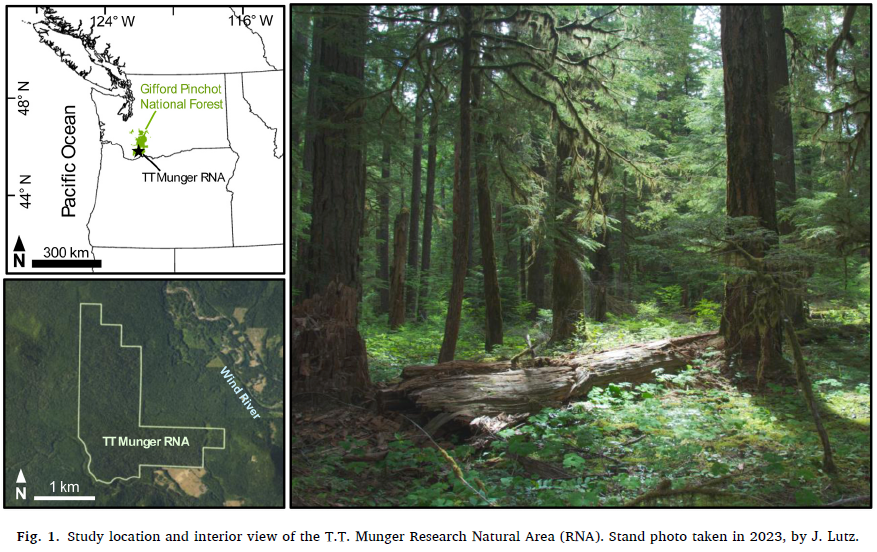
Although considered a relatively stable successional stage, old-growth forests can be dynamic, owing to both endogenous (life history, population dynamics) and exogenous (disturbance, global change) processes. Given the long timescales involved, direct tests of basic theories regarding old-growth development, or detecting global change impacts, are scarce – often relying on space-for-time substitutions instead. Using a 72-year-long dataset in a ~500-year-old temperate forest in the western Cascades, USA, we examined how population, community, and ecosystem states and processes changed over time – encompassing periods of relatively stable climate (1947–1980s) and rapid climate change (1990s-2019). An initial population of 4597 trees was assessed every 4–8 years for growth, recruitment, and mortality across a 478-hectare forest.
For the first half-century of observation, system dynamics were notably consistent with successional theory absent significant disturbance. The long-lived, shade-intolerant species (Pseudotsuga menziesii) attenuated slowly (from 53% to 47% of basal area), while the principal shade-tolerant species (Tsuga heterophylla, Abies amabilis) proportionally increased. Overstory gap formation/expansion and understory tree recruitment progressed, while overall mortality rates, basal area, and aboveground woody biomass were largely stable. Beginning in the 2000s, dynamics departed from theoretical patterns: markedly higher mortality rates among shade-tolerant species – coinciding with increasing climatic water deficit – catalyzed declines in basal area and live biomass (partly buffered by dead-wood biomass). Shade-tolerant tree regeneration surged, suggesting higher turnover and impacts to vertical structure. Whether recent shifts are transient or sustained is yet uncertain. Long-term datasets are crucial to tracking endogenous and exogenous changes to forest development in the global change era.
Citation
Daniel C. Donato, Jerry F. Franklin, John L. Campbell, James A. Freund, Mark E. Harmon, Brian J. Harvey, Andrew J. Larson, James A. Lutz, Mark E. Swanson. Accelerated tree mortality after a half-century of stability in an old-growth forest: Insights from a 72-year study. Forest Ecology and Management 618, (2026). https://doi.org/10.1016/j.foreco.2026.124012.