
Academic Portfolio Review
This content was updated on September 1, 2026 after the Office of the Provost concluded our data validation, made program notifications, and published current APR data.
The purpose of Academic Portfolio Review is to conduct an annual analysis guided by metrics defined in BOR Policy 303.3 Program Review and other data identified to evaluate program health, sustainability, and student success. Official recommendations resulting from the Academic Portfolio Review are initiated through Faculty Senate and Board of Regents procedures.
Beginning with the 2026–27 cycle, APR incorporates the Montana University System's new Ongoing Program Review as its foundation. This annual, threshold-based review is conducted by the Office of the Commissioner of Higher Education (OCHE) and now runs system-wide.
OCHE Pilot
The 2026–27 academic year will serve as a pilot of the new process before taking full effect in August 2027. During the pilot, no program actions will result, unless they are voluntary on the part of the offering academic unit. The pilot's purpose is to validate the underlying data, test the forms and timelines, and gather campus and faculty feedback. Faculty input during the pilot year will directly shape the final Academic Affairs Handbook procedures, forms, and metrics.
OCHE will evaluate programs at the 4-digit CIP code, degree level, and campus level, using three metrics: a headcount floor, a three-year headcount trend, and a three-year graduation floor. If a program crosses a single threshold (1), it is then flagged Red (Enhanced Review) or Yellow (Monitor). A flag is not a decision about a program's future. It creates an obligation to review the program, document improvement plans, and come to a reasonable determination about the program's future.
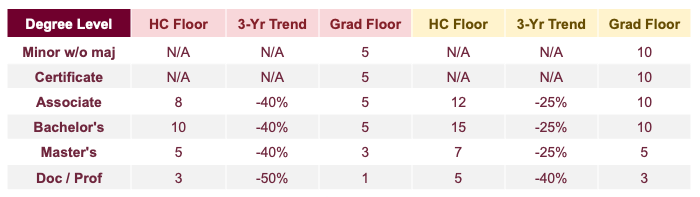
Because OCHE's thresholds are calculated at the CIP-code level, a single CIP grouping can combine more than one UM program (for example, if all biology majors and concentrations at the baccalaureate level fall under the same CIP they will be reviewed together). APR looks at each individual UM program separately. Academic Portfolio Review will address trends in enrollment and completion that CIP-level aggregation alone might miss.
Update: the previous published thresholds included minors without majors, certificates, and concentrations. These thresholds have been withdrawn for the pilot year.
Upcoming Trainings
We currently have scheduled several trainings for chairs and department staff for accessing and using Tableau for Academic Portfolio Review and other administrative purposes. Click the links for more information and to register on GrizHub.
Department Chairs and Program Directors
Sept 9, 11:00 am, Mansfield Library
Sept 28, 1:00 pm, Mansfield Library
Department Admins and Program Coordinators
Sept 29, 9:00 am, Mansfield Library
Additional sessions for staff, budget analysts, and AFOs to be announced.
Thresholds
-
Red — Enhanced Review: Headcount floor 8; 3-yr headcount trend -40%; 3-yr graduation floor 5
Yellow — Monitor: Headcount floor 12; 3-yr headcount trend -25%; 3-yr graduation floor 10
-
Red — Enhanced Review: Headcount floor 10; 3-yr headcount trend -40%; 3-yr graduation floor 5
Yellow — Monitor: Headcount floor 15; 3-yr headcount trend -25%; 3-yr graduation floor 10
-
Red — Enhanced Review: Headcount floor 5; 3-yr headcount trend -40%; 3-yr graduation floor 3
Yellow — Monitor: Headcount floor 7; 3-yr headcount trend -25%; 3-yr graduation floor 5
-
Red — Enhanced Review: Headcount floor 3; 3-yr headcount trend -50%; 3-yr graduation floor 1
Yellow — Monitor: Headcount floor 5; 3-yr headcount trend -40%; 3-yr graduation floor 3
2026-2027 Process
Update: This section has been updated to better reflect the guidance included by OCHE with the pilot data and how that data will be integrated into APR for 2026-2027.
Pilot Calendar
- August 21, 2026 | OCHE provides the list of programs flagged for enhanced review to campuses.
- September 2026 | Board of Regents considers revised Policy 303.3 for approval.
- September 30, 2026 | Chief academic officer petition for removal from the list due to OCHE.
- November 2026| Pilot enhanced review list reported to BOR (information only)
- January 15, 2027 | Campus practice responses due to OCHE
- March 2027 | Pilot outcomes and lessons learned reported to the BOR
- Spring 2027 | Pilot evaluation; handbook, forms, and metrics finalized
- August 2027 | Ongoing program review takes effect
Campus Response Process
Programs on the pilot enhanced review list require a campus response by January 15. Any voluntary program moratoria or terminations will be submitted to Faculty Senate by the Spring Curriculum Deadline. Program modifications resulting from improvement plans can be submitted the following fall.
Individual Program-Level Review
Alongside OCHE's system-level thresholds, UM disaggregates its own data to the individual program level for every program on campus beyond the CIP-level groupings used by OCHE. Program-level data for this review is available to all programs in a tableau dashboards that integrate the OCHE review thresholds.
How APR Findings Are Shared with Campus
APR results reach campus in two stages each cycle:
- OCHE's system-level findings are shared with campus as soon as they're available, along with an explanation of what they show, their limitations, and what to expect next.
- Programs identified using OCHE thresholds are prioritized for early, individual conversations with the Office of the Provost.
- APR analysis is disaggregated to the individual program level alongside the OCHE thresholds will be used in program planning during the academic year and as part of the Student Learning Assessment process in the spring.
Faculty Senate retains the right to review and recommend campus all curriculum and items of academic concern. Any program Modifications and proposals to place programs in to moratorium or termination will be reviewed through established curriculum review processes.
Academic Portfolio Review Resources
-
This workbook is the pilot flagged-program list for UM. AY 2026–27 is a PILOT — a practice cycle to validate the data, test the forms and timeline, and gather feedback. No program actions result from the pilot. Program titles are as maintained by OCHE for this review. One 4-digit CIP may include several named majors or concentrations.
-
Program completion trends using OCHE's Ongoing Program Review thresholds from FY23 to FY25. NetID login and Tableau access required. Links on the right hand filter menu include a video demonstration and data guide.
-
Program enrollment trends using OCHE's Ongoing Program Review thresholds from FY23 to FY26. NetID login and Tableau access required. Links on the right hand filter menu include a video demonstration and data guide.
-
No Tableau access yet? Request it here.
-
Questions or concerns about the data, thresholds, or process.
-
Briefing explaining the AY 2026–27 Program Review Pilot and answers to anticipated questions.
-
Draft, pilot year — required for programs whose campus response is an improvement plan. (Not every Red-flagged program follows this pathway; some are petitioning for removal instead. Check your program's individual notification to confirm which applies.)
-
Draft, pilot year — due within 30 days of the flagged list.
-
Draft, pilot year — required attachment supporting the resource assessment section of the Campus Response.
-
Findings, recommendations, and results from past Academic Portfolio Reviews.
-
Archived campus communications related to APR sent out via the Academic Affairs Newsletter.