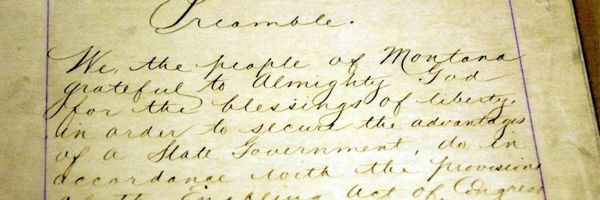
Montana Constitution of 1972
"(1) All existing rights to the use of any waters for any useful or beneficial purpose are hereby recognized and confirmed. (2) The use of all water that is now or may hereafter be appropriated for sale, rent, distribution, or other beneficial use, the right of way over the lands of others for all ditches, drains, flumes, canals, and aqueducts necessarily used in connection therewith, and the sites for reservoirs necessary for collecting and storing water shall be led to be a public use. (3) All surface, underground, flood, and atmospheric waters within the boundaries of the state are the property of the state for the use of its people and are subject to appropriation for beneficial uses as provided by law. (4) The legislature shall provide for the administration, control, and regulation of water rights and shall establish a system of centralized records, in addition to the present system of local records."
History
Sources
1889 Montana Constitution
Article III, Section 15 of the 1889 Constitution stated, "The use of all water now appropriated, or that may hereafter be appropriated for sale, rental, distribution or other beneficial use and the right of way over the lands of others, for all ditches, drains, flumes, canals and aqueducts, necessarily used in connection therewith, as well as the sites for reservoirs necessary for collecting and storing the same, shall be held to be a public use."
Drafting
Delegate Earl Berthelson introduced the first proposal of the section to the Constitutional Convention on January 20, 1972. This delegate proposal was the second proposal at the Convention. Mont. Const. Con. Proceedings, Vol. 1, p. 76 The initial draft read, "All of the water in this state, whether occurring on the surface or underground, and whether occurring naturally or artificially, belongs to the people of Montana; and those water which are capable of substantial or significant public use may be used by the people with or without diversion or development works, regardless of whether the waters occur on public or private lands. The public has the right to the recreational use of such waters and their beds and banks to the high water mark regardless of whether the waters are navigable and regardless of whether the beds and banks are privately owned. Beneficial use of waters includes recreation and aesthetics, such as habitat for fish and wildlife and scenic waterways." Id. "The use of all water now appropriated, or that may hereafter be appropriated for sale, rental, distribution, or other beneficial use, and the right of way over lands of others, for all ditches, drains, flumes, canals, and aqueducts, necessarily used in connection therewith, as well as the sites for reservoirs necessary for collection and storing the same, shall be held to be a public use." Id. "The legislature may provide either directly, or indirectly through administrative agencies, for the control and regulation of both existing and future rights to uses of water." Id. This proposal was adopted in part by the Committee. Mont. Const. Con. Proceedings, Vol. 2, p. 564.
Delegate Mark Etchart introduced another water rights proposal on January 28, 1972 (the 48th delegate proposal). Mont. Const. Con. Proceedings, Vol. 1, p. 145. His proposal said, "All surface and subsurface water shall forever remain the property of the people of Montana and subject to appropriation for beneficial uses as provided by law." Id. "Priority of appropriation for beneficial uses shall give the better right. No appropriation shall be denied except when such denial is demanded by the public interests." Id. This proposal was adopted in part by the Committee. Mont. Const. Con. Proceedings, Vol. 2, p. 564.
On February 2, 1972, Delegate Marian S. Erdmann and several others proposed a constitutional article regarding irrigation and water rights (proposal no. 96). Mont. Const. Con. Proceedings, Vol. 1, p. 213. This proposal stated, "Section 1. Water is state property. The water of all natural streams, springs, lakes or other collections of still water, within the boundaries of the state, are hereby declared to be the property of the state. Section 2. Board of control. There shall be a board of control, to be composed of the state engineer and superintendents of the water divisions; which shall, under such regulations as may be prescribed by law, have the supervision of the water of the state and of their appropriation, distribution and diversion, and of the various officers connected therewith. Decisions of the board shall be subject to review by the courts of the state. Section 3. Priority of appropriation. Priority of appropriation for beneficial uses shall give the better right. No appropriation shall be denied except when such denial is demanded by the public interests. Section 4. Water divisions. The legislature shall by law divide the state into six (6) water divisions, and provide for the appointment of superintendents thereof. Section 5. State engineer. There shall be a state engineer who shall be appointed by the Governor of the state and confirmed by the senate; he shall hold his office for the term of six (6) years, or until his successor shall have been appointed and shall have qualified. He shall be president of the board of control, and shall have general supervision of the waters of the state and of the officers connected with its distribution. No person shall be appointed to this position who has not such theoretical knowledge and such practical experience and skill shall fit him for the position." Id. This proposal was adopted in part by the Committee. Mont. Const. Con. Proceedings, Vol. 2, p. 565.
On February 3rd, 1972, delegate Carl M. Davis and others introduced delegate proposal no. 127 for a new constitutional section providing for water rights. Mont. Const. Con. Proceedings, Vol. 1, p. 255. This proposal read as, "Section _. Water Rights. (1) All existing rights to the use of any waters in this state for any useful or beneficial purpose are hereby recognized and confirmed. (2) All surface, ground, and atmospheric waters within the boundaries of the state of Montana are declared to be properties of the state and subject to appropriation for beneficial uses as provided by law. (3) The legislature shall vest in an agency of the executive branch of state government, under laws which shall be prescribed by the legislature, the administration, control and regulation of existing and future rights to and uses of water." Id. This proposal was adopted in part by the Committee. Mont. Const. Con. Proceedings, Vol. 2, p. 565.
These proposals were referred to the Natural Resources and Agriculture Committee during the Montana Constitutional Convention. The Committee was chaired by Louise Cross. The vice-chairmen was E.S. "Erv" Gysler. The other committee members were Geoffery L. Brazier, Henry L. Siderius, John H. Anderson, Jr., A.W. Kamhoot, Douglas Delaney, Charles B. McNeil, and Donald Rebal. Mont. Const. Con. Proceedings, Vol. 2, p. 553. On February 17th, 1972, the Committee made a majority proposal to the Constitutional Convention. Id., at 552-553. The majority proposal was identical to the adopted section except that it included two additional subsections. Proposed subsections (1), (2), and (3) were identical to the corresponding adopted subsections. Proposed subsection (4) stated, "Beneficial uses include, but are not limited to, domestic, municipal, agriculture, stockwatering, industry, recreation, scenic waterways, and habitat for wildlife, and all other uses presently recognized by law, together with future beneficial uses as determined by the legislature or courts of Montana. A diversion or development work is not required for future acquisition of a water right for the foregoing uses. The legislature shall determine the method of establishing those future water rights which do not require a diversion and may designate priorities for those future rights if necessary." Proposed subsection (5) stated, "Priority of appropriation for beneficial uses shall give the better right. No appropriation shall be denied except when such denial is demanded by the public interests." Proposed subsection (6) mirrored the adopted subsection (4). Id.
Th comments on majority proposal said, "Your committee feels that water and water rights are of crucial importance to the past history and future development of the State of Montana. For this reason the committee feels justified in expanding the present Constitutional section which relates solely to the use of water to include provisions for the protection of the waters of the state for use by its people." Mont. Const. Con. Proceedings, Vol. 2, pp. 556-557. "Subsection (1) guarantees all existing rights to the use of water and includes all adjudicated rights and nonadjudicated rights including water rights for which notice of appropriations has been filed as well as rights by use for which no filing is of record." Id., at 557. "Subsection (2) is a verbatim duplication of Article III, section 15 of the present Constitution (the 1889 Constitution) and has been retained in its entirety to preserve the substantial number of court decisions interpreting and incorporating the language of this section." Id. "Subsection (3) is a new provision to establish ownership of all waters in the state subject to use by the people. This does not in any way affect the past, present or future right to appropriate water for beneficial uses and is intended to recognize Montana Supreme Court decisions and guarantee the state of Montana standing to claim all of its waters for use by the people of Montana in matters involving other states and the United States Government." Id. "Subsection (4) is a new provision to permit recreation and stockwatering to acquire a water right without the necessity of a diversion. This applies only to future rights and, of course, only to waters for which there are no present water rights. This subsection further provides that future agricultural and industrial water development will not be foreclosed by recreation, as it is left up to the legislature to determine the method of establishing a future water right without a diversion and the legislature is further authorized to establish priorities of water uses for those waters where the legislature decrees priorities necessary." "Subsection (5) acknowledges a continuance of our present water law principle that the first appropriation in time is the better right and provides that not future appropriations shall be denied except in the public interest." Id. "Subsection (6) mandates the legislature to administer, control and regulate water rights. This does not in any way change the present legislatively established system of local control of adjudicated waters by water commissioners appointed by the District Court having jurisdiction. A new requirement is added to establish a system of centralized records of all water rights in addition to the present statutory system of local filing of records. The centralized records are intended to provide a single location for water rights information and a complete record of all water rights." Id. There appears to be no minority report on this section.
The Natural Resources and Agricultural Committee heard from many water rights witnesses during their deliberations, including: John C. Spindler from the Anaconda Company; Fred Wetzsteon, a farmer from Sula; Albert W. Stone, a water use and rights law professor; Elmer Cax, the president of the Montana National Farmers Organization; Charles Bowman, the head of the agricultural experiment station; James A. Stewart from the Montana Quality Commodities, Inc.; Alex Mogan from Montana Quality Products, Inc.; Clyde Jarvis, president of the Montana Farmers Union; Senators Gordon McGowan and Senator McOmber, also ranchers; Mons Teigen the secretary of Montana Stockgrowers Association; David A. Smith the secretary-treasurer of the Montana Wool Growers Association; Harvey Griffir, a rancher; John C. Paugh, a farmer; John Ray , a leacher; Ed Lenhardt from High Line Ditch Company; and Bill Staley from the Big Ditch Company. Mont. Const. Con. Proceedings, Vol. 2, pp. 567-571.
Clerk Smith read proposed section 3, subsection (1) to the Convention. Mont. Const. Con. Proceedings, Vol. 5, p. 1301. Delegate Murray moved to adopt subsection (1). Id. Delegate McNeil then stated, "water and water rights are of crucial importance..." Id. He went on to explain what each subsection said and gave the committee comments. Id. Delegate Erdmann also emphasized that water rights would be one of the most important decisions the Convention would make. Id., at 1301-1302. He also declared it was important for the Constitution to say that all of the water in the State were the property of the State for the use of the public. Id. This would allow the State to have standing when negotiating inter-state, federal, and tribal water compacts. Id. Subsection (1) then passed with unanimous consent. Id., at 1302-1303.
Clerk Smith then read proposed section 3, subsection (2). Monst. Const. Con. Proceeding, Vol. 5, p. 1303. Because this section was a verbatim reprint of the 1889 Constitution's water rights section, the Convention unanimously adopted it. Id.
Next, Clerk Smith read proposed section 3, subsection (3). Mont. Const. Con. Proceeding, Vol. 5, p. 1303. Delegate Aronow moved to remove the words "for the use of its people and" from the subsection. Id. His concern was that the words allowed recreationalists to cross private land to get to water. Id., at 1303-1305. However, this amendment was opposed by several other delegates. Id., at 1305-13010 Delegate Wilson offered a solution to the problem. Id., at 1310. He suggested adding the language "This section is not intended to authorize trespass over private property except as provided by law." Id. After some debate both motions were voted on and both failed to pass. Id. In the end, subsection (3) unanimously passed as written. Id., at 1312.
Then Clerk Smith read proposed section 3, subsection (4). Mont. Const. Con. Proceedings, Vol. 5, p. 1312. Subsection (4) proved to be very contentious. Many delegates did not believe non-diversionary appropriations were beneficial uses. Others thought that by allowing recreational uses fishermen, boaters, and recreational groups would be able to appropriate large quantities of water so that none would be left for future water development. Delegate Wilson proposed amending the subsection so that non-diversionary uses would always be junior to diversionary uses. Id. Delegate McNeil stated that Professor Stone (a water law professor at the University of Montana) was of the opinion that beneficial uses should not be locked into different priorities. Id., at 1318-1319. However, Delegate Schiltz suggested the subsection could be rewritten in the Rules Committee room during a short recess. Id., at 1325. The Convention recessed for 38 minutes. Id. During that time, in the Rules Committee room, no rewriting of subsection (4) was possible. Id., at 1326. Finally, Delegate McNonough moved to delete subsection (4) again. After a roll call vote subsection (4) was deleted. Id., at 1342-1343.
Delegate Berg then attempted to insert a new subsection (4) which read "Jurisdiction to administer and control the right to use of waters in adjudicated streams is vested in the District Court." Mont. Const. Con. Proceedings, Vol. 5, p. 1343. Delegate Berg stated that he was concerned about a state agency administering water rights. Id. After another roll call vote the motion failed. Id., at 1345-1346.
Clerk Hanson then read proposed section 3, subsection (5). Mont. Const. Con. Proceedings, Vol. 5, p. 1346. Delegate Etchart stated that he made a drafting error and the second sentence should be deleted. Id. Thus, the subsection would read as "The priority of appropriation for beneficial use shall give the better right." Delegate Davis pointed out that this new wording was only a restatement of the existing water law. Id., at 1348. Delegate Vermillion then made a substitute motion to delete subsection (5) in its entirety. Id. The motion passed and subsection (5) was deleted. Id.
After a failed motion to recess, Clerk Hanson then read proposed section 3, subsection (6). Mont. Const. Con. Proceedings, Vol. 5, p. 1348-1349. Delegate Berg moved to delete subsection (6) because he felt it should be left to the Legislature. Id., at 1349. After several objections the motion failed to pass and subsection (6) was adopted. Id., at 1350-1351.
Thus, the Section now read as, "Section 3. Water Rights. (1) All existing rights to the use of any waters in this state for any useful or beneficial purposes are hereby recognized and confirmed. (2) The use of all water now appropriated for sale, rental, distribution, or other beneficial use, and the right of way over the lands of others, for all ditches, drains, flumes, canals, and aqueducts, necessarily used in connection therewith, as well as the sites for reservoirs necessary for collecting and storing the same, shall be held to be a public use. (3) All surface, underground, flood, and atmospheric waters within the boundaries of the state of Montana are declared to be the property of the state for the use of its people and are subject to appropriation for beneficial uses as provided by law. (4) The legislature shall provide for the administration, control, and regulation of water rights and shall establish a system of centralized records, in addition to the present system of local filing of records." Mont. Const. Con. Proceedings, Vol. 2, p. 933.
The Committee on Style and Drafting made a few, minor changes to the final draft of the Section. Mont. Const. Con. Proceedings, Vol. 2, pp. 929-933. In subsection (1) the Style and Drafting Committee deleted the words "in this state." Id., at 933. In subsection (2) the Committee deleted the words ", or that hereafter may be appropriated", "as well as", and "the same." Id. The Committee added the words "that is" and "or may hereafter be." Id. The Committee substituted the word "rental" for "rent." Id. In subsection (3) the Committee deleted the words "in Montana" and "declared to be." Id. In subsection (4) the Committee deleted the words "filing of." Id.
On March 14th, 1972, the Convention adopted Section 3 as edited by the Committee on Style and Drafting. Mont. Const. Con. Proceedings, Vol. 6, pp. 2213-2214.
Ratification
Interpretation
.
Commentary
.