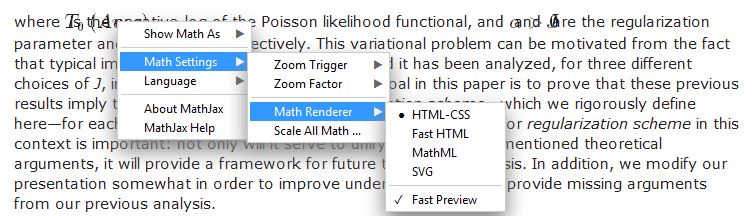
If mathematical formulas are not correctly displayed, try changing the MathJax output format.
Fall 2026
-
Eric Marland – University of Montana
Communicating Science: Patterns and Practice
In this talk I will give an introduction to the crucial importance of communication skills in scientific fields and how to develop and refine them. I will share insights on key issues and share a few fun activities that provide practice for some of the basic skills. This talk will provide several opportunities for audience participation.
September 21, 2026 at 3:00 p.m. Math 103
-
Patrick Kreitzberg – University of Montana, PhD Candidate
C*-Algebras: K-graph and Groupoid Homology
A k-graph is a colored directed graph with some extra structure. From a k-graph one can construct a groupoid and a C*-algebra. For a C*-algebra constructed from a k-graph, one can calculate different homologies for the C*-algebra, based on either the k-graph or on the groupoid. We discuss the relationship between the k-graph homologies of C*-algebras whose groupoids are isomorphic.
September 28, 2026 at 3:00 p.m. Math 103
-
Atish Mitra – Montana Tech
What Inverse Limits See: Reconstructing Shapes from Finite Samples
Suppose a shape sitting in Euclidean space is known to us only through a finite set of sample points scattered near it. How much of the shape can be recovered, and in what sense? This is the reconstruction problem, and the standard topological tool for it is the Vietoris–Rips complex, built by declaring mutually close sample points to span a simplex. It often recovers the homotopy type of the shape, but it is an abstract complex that lives nowhere in particular. Its shadow, the union of the convex hulls of its simplices, does live in the ambient space, and so offers a genuine geometric reconstruction rather than a purely topological one.
The projection from the complex onto its shadow can be badly singular, and is understood only in low ambient dimensions. I will explain what goes wrong, and then describe a way around it: rather than fixing one scale and one sample, study the whole system of shadows as the scale shrinks and the sample fills out the shape. Borsuk's shape theory turns out to be the right setting, since it was built precisely for situations where a space is best understood through an inverse system approximating it. In the limit the projection behaves well on homotopy and homology under mild hypotheses, and in favorable cases the limit stabilizes and recovers the shape up to its embedding. Joint work with Kazuhiro Kawamura and Sushovan Majhi.
October 19, 2026 at 3:00 p.m. Math 103
-
Faculty Evaluation Committee meeting
October 26, 2026 at 3:00 p.m. Math 103
-
Katia Smirnova –
November 2, 2026 at 3:00 p.m. Math 103
Available Dates for Fall 2026 & Spring 2027
November 9, 16, 23, 30
February 1, 8, 22
March 1, 8, 22, 29
April 5, 12, 19, 26
Spring 2027
-
Matthias Morzfeld – Institute of Geophysics and Planetary Physics (IGPP) at Scripps Institution of Oceanography
Randomized blocky Occam: A practical algorithm for generating blocky models and associated uncertainties
We present new numerical tools for geophysical inversion and uncertainty quantification (UQ), with an emphasis on blocky (piecewise-constant) layered models that can reproduce sharp contrasts in geophysical or geological properties. The new tools are inspired by an ‘old’ and very successful inversion tool: regularized, nonlinear inversion. We combine Occam’s inversion with total variation regularization and a split Bregman method to obtain an inversion algorithm that we call blocky Occam, because it determines the blockiest model that fits the data adequately. To generate an UQ, we use a modified randomize-then-optimize approach (RTO) and call the resulting algorithm RamBO (randomized blocky Occam), because it essentially amounts to running blocky Occam in a randomized parallel for-loop. Blocky Occam and RamBO inherit computational advantages and stability from the combination of Occam’s inversion, split Bregman and RTO, and, therefore, can be expected to be robustly applicable across geophysics. I will illustrate the use of RamBO and blocky Occam on several electromagnetic (EM) inversions and show some progress towards 2D EM inversions as well. This is joint work with Eliana Vargas-Huitzil and Steven C. Constable (both at Scripps Institution of Oceanography, University of California, San Diego).
January 25, 2027 at 3:00 p.m. Math 103
-
If mathematical formulas are not correctly displayed in your browser, try changing the output format of MathJax.
To do this, right-click on a formula, select "Math Settings", then "Math Renderer", and choose one of the other output formats (for example, MathML or SVG).